A key to dental implant success is the quantity and quality of the bone where the implant is to be placed. The upper back jaw has traditionally been one of the most difficult areas to successfully place dental implants due to insufficient bone quantity and quality and the close proximity to the sinus. If you’ve lost bone in that area due to reasons such as periodontal disease or tooth loss, you may be left without enough bone to place dental implants, and as such, may require either sinus lift surgery or bone augmentation.
A sinus lift prepares your upper jaw for the placement of dental implants.

This is great news if you’ve previously been told you’re not a candidate due to lack of bone height.
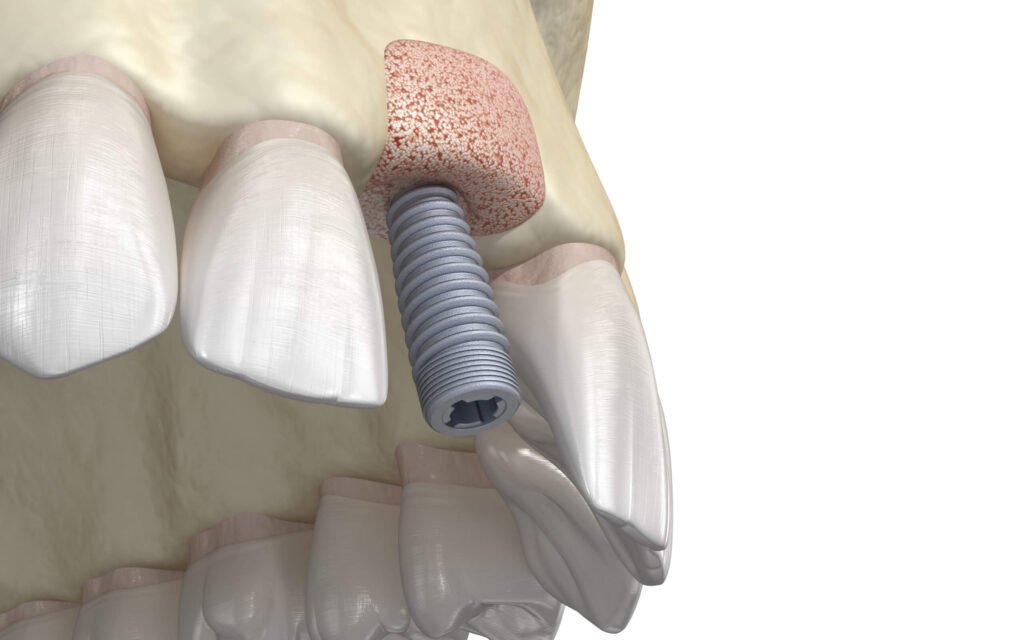
A sinus lift is a bone grafting procedure that creates the required bone height—usually around five millimetres—for secure implant placement.
It involves gently lifting the sinus membrane and placing bone material between the upper jaw and the maxillary sinuses.
This procedure is especially helpful if you’ve had missing teeth for a long time and bone resorption has occurred. By increasing bone volume, we create a stable foundation for implants.
Before your sinus lift, we will carry out a clinical and radiographic assessment.
This includes a CBCT (cone beam CT) scan to measure bone height and check the health of your sinuses.
If you don’t have enough natural, healthy bone to support an implant, you may need bone augmentation.
This process rebuilds the bone to provide a strong base for future dental implants.
Bone augmentation often involves a bone graft.
This is where grafting material is placed onto your existing jawbone. Over time, it fuses with your natural bone to create a stable implant site.
Modern bone grafting is a minimally invasive and usually painless procedure done right in our practice.
After placement, the graft needs 3 to 6 months to heal, depending on the extent of the graft and your bone’s condition.
Once healed, the area will be ready for implant placement.
There are several options for grafting material. Your dentist will discuss these with you during treatment planning:
All materials are thoroughly processed to eliminate any risk of infection or disease transmission.
We now offer an Advanced Dentistry Referral Service for complex implant cases.
Referrals are welcome from both dental professionals and patients directly.
We use state-of-the-art CBCT imaging to plan treatments with precision and confidence.
At Modbury Dental Practice, we aim to see referred patients within 7 days of receiving the referral.
Please contact us for more details or to arrange a consultation.
Back to Advanced Dentistry